
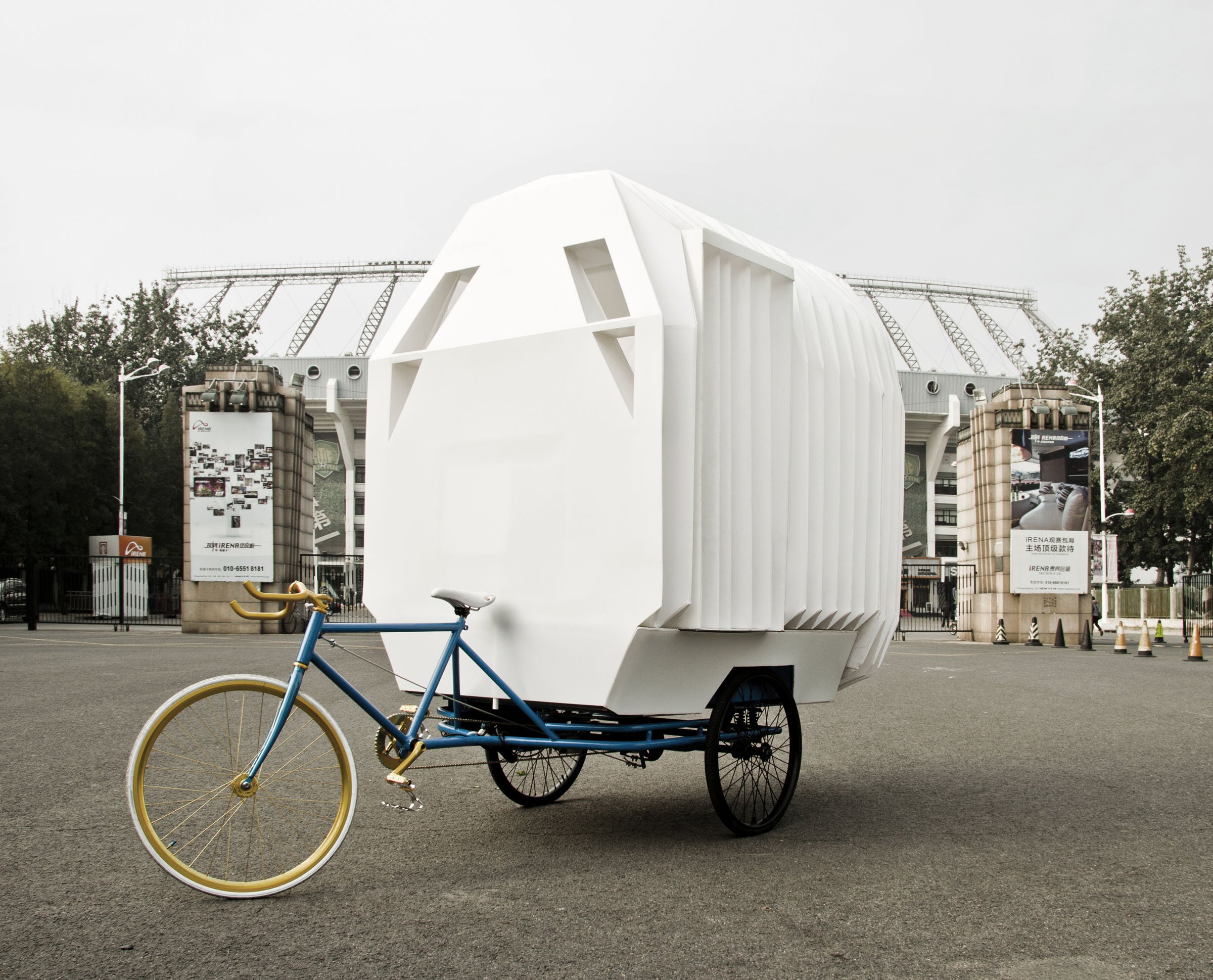
Tricycle House
LOCATION
Beijing, China
DATE
2012
CLIENT
Modern Media
TYPE
Temporary Art Installation
TEAM
James Shen, He Zhe, Zang Feng, Lian Junqin, Niu Lei, Yang Bing, Xu Xiaoyu, He Xuantong, Cai Richao
In China, private ownership of land does not exist, therefore the Tricycle House suggests a future embrace of the temporary relationship between people and the land they occupy. In a crowded Chinese city, single-family homes can be affordable and sustainable, parking lots are used at night, and traffic jams are acceptable.
We experimented with folded plastic as a construction method. Each piece of the house is cut with a CNC router, scored, folded, and welded into shape. The plastic, polypropylene, can be folded without losing its strength. Therefore the house can open up to the outside, expand like an accordion for more space, and connect to other houses. The plastic is translucent, allowing the interior to be lit by the sun during the day or street lamps at night.
The Tricycle House is man-powered and operates off-the-grid. Facilities in the house include a sink and stove, a bathtub, a water tank, and furnitures that can transform from a bed to a dining table and bench to a bench-and-counter-top. The sink, stove, and bathtub can collapse into the front wall of the house.


