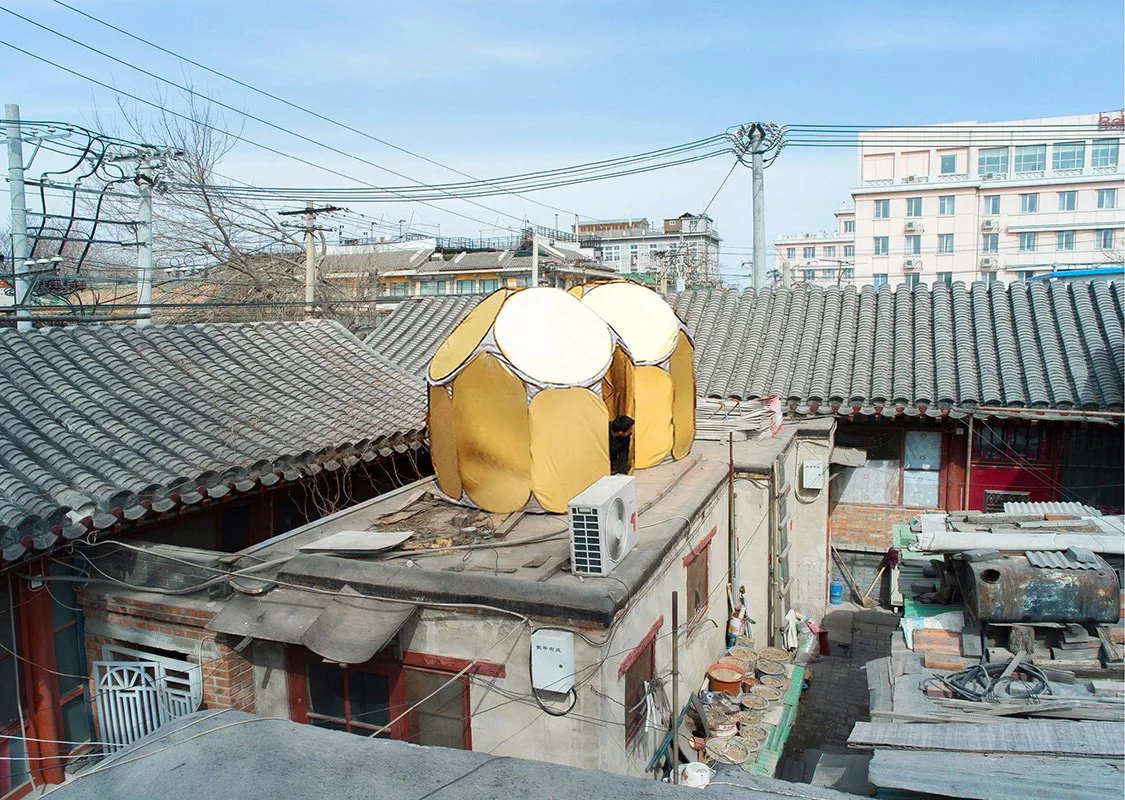
Pop-Up Habitat
LOCATIONS
Beijing, Guangzhou, Shenzhen, and Wuxi, China; Seoul, Korea; and New York
DATE
2013
TYPE
Temporary Public Installation
TEAM
James Shen, He Zhe, Zang Feng, Niu Lei, Chen Yanjie
Developed in Beijing, the Pop-Up Habitat is a modular and lightweight multi-purpose structure that re-purposes reflective panels commonly used in photography. The popularity of amateur photography was a recent phenomenon to 2010s’ China. The familiar sight of photographers using reflective panels served as our inspiration.
The Pop-Up Habitat makes use of and exaggerates the inherent qualities of these reflective panels—rigidity, flexibility, and collapsibility. Pop-Up’s modules are attached to each other with just Velcro and are easily assembled. We used flexible steel rings combined with soft fabric to produce a rigid collapsible structure that is extremely light. The soft structure allows the Pop-Up Habitat to fold into a fraction of its expanded size, while the assembled form’s geometry allows it to be used as a free-standing structure able to span large spaces. The design is instantly deployable, and goes from flat panels to enclosed space in just minutes.
The Pop-Up Habitat is customizable and can be formed into arches and rooms, linear spaces, or stacked vertically to create multi-story free-standing structures. It has been exhibited in a variety of forms including auditorium, gallery, and canopy in diverse locations—historic, commercial, suburban and city center, inside and outside. In one exhibition, the Pop-Up Habitat became an unintended but apt backdrop for selfies.
A consumer version of the Pop-Up Habitat is available as a weatherproof modular tent. Portable and quickly deployable, the tent offers the possibility of living just about anywhere. The individual modules can attach to each other to create multi-room structures and covered leisure spaces. These shimmering modules offer an infinitely expandable temporary city.
Playful and visually appealing, the simplicity of constructing the Pop-Up Habitat allows even children to be architects, constructing their own spaces for play and discovery. Anyone can construct their own building, customizing the shape to fit their own needs.